

90% Course Completion Rate

Training Professionals Since 2016

Personalised Trainer Support

Trusted Across APAC
 What is Lean Six Sigma Black Belt Certification?
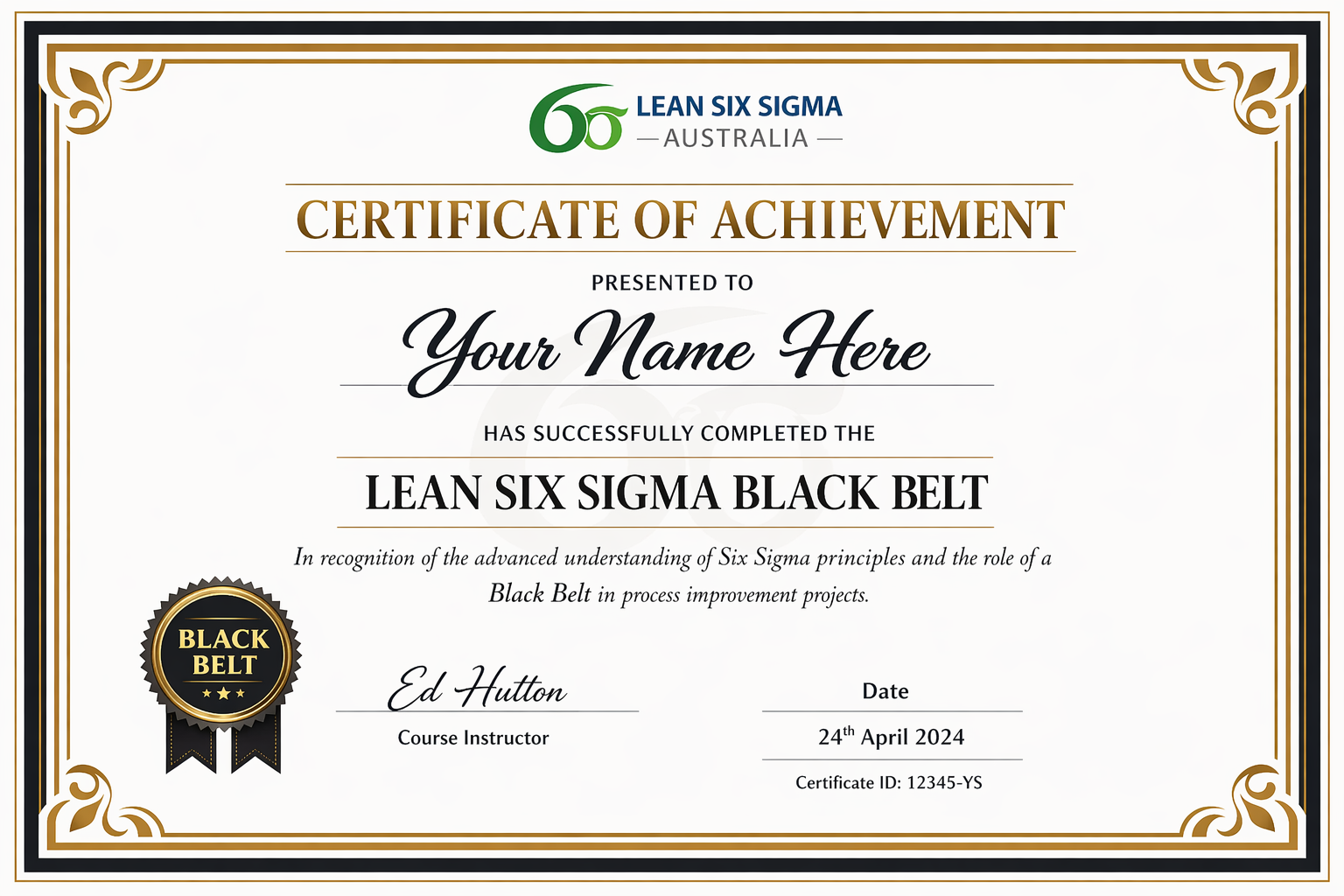
Lean Six Sigma Black Belt Certification is a self-paced online training course covering advanced strategy, analysis, and leadership-level process improvement. It requires Six Sigma Yellow Belt and Green Belt as prerequisites, costs $2,495.00, and involves approximately 30–40 hours of study, to be completed within six months. Upon completion, you’ll receive an internationally recognized certification. This globally recognised Lean Six Sigma Black Belt pathway follows the DMAIC methodology defined by the American Society for Quality (ASQ), the leading authority on Six Sigma standards.
The Lean Six Sigma Black Belt is the top of the Lean Six Sigma pathway — built for professionals who are ready to move beyond running individual projects into coaching teams and shaping strategy.
Why Lean Six Sigma Black Belt Course?
As an organization, you need change agents who will lead strategic efforts to improve processes that will result in quality products and services while reducing costs and increasing revenue. This is where the Lean Six Sigma Black Belt comes in. It gives them the requisite expertise to spot and remove any process variation, waste or defect and ultimately hit your organizational bottom-lines. Our Lean Six Sigma Black Belt certification gives these change agents the advanced tools to lead that transformation with confidence.
As an Individual professional, you will super-charge your career potential when you become a Lean Six Sigma Black Belt. You will become a sort-after professional and strategist who will most likely become a part of the management team where critical and strategic process decisions are made. Also, your earning potential will be greatly enhanced. A Lean Six Sigma Black Belt certification signals to employers that you can lead complex, high-value improvement initiatives from day one.
Prerequisite: To obtain this Lean Six Sigma Black Belt certification, You must have the Six Sigma Yellow Belt and the Lean Six Sigma Green Belt certifications
Expected Learning Outcome
At the end of this course, you will
- Have an exhaustive understanding of ALL aspects of This includes the overview and meaning of Quality, the gurus of Quality and their contributions, etc.
- Get a full understanding of each component of DMAIC, DMADV and DFSS, and how to apply them to real-life projects
- Deeply understand how to specifically maximize the various DMAIC stages namely: Define, Measure, Analyse, Improve, and control in solving process problems
- Learn and be able to implement strategic leadership principles like team formation, facilitation, dynamics, time management, performance evaluation and reward, e.t.c.
- Get a deeper understanding of Lean Methodology and all its techniques namely: Value Stream Map, Lean Speed, Total Supply Chain, and Lean Six Sigma Logistics
- Acquire the ability to identify key factors that drive your organization and develop plans, as well as streamlining processes to achieve goals
- Be able to use Six Sigma knowledge and skill to positively disrupt organizational processes; establish improvement techniques and ingrain them into the organization’s process culture
Full Course Details:
- Introduction to Six Sigma
- A brief history of Quality
- What is Quality (Definitions) and service or product
- Quality Gurus & their contribution to Quality
- Enterprise-wide View
- Leadership
- Six Sigma Roles and Responsibilities
- Team Formation
- Team Facilitation
- Team Dynamics
- Time Management For Teams
- Team Decision-making Tools
- Management and Planning Tools
- Team Performance Evaluation And Rewards
- Six Sigma Methodology – Define
- Important Stakeholders
- Impact On Stakeholders
- Critical To Requirements
- Benchmarking
- Business performance measures
- Financial measures
- VOC
- Kano’s Customer Satisfaction Levels
- Juran’s Customer Needs
- Market Research
- CTQ Flow down
- QFD
- Performance Metrics
- Project Charter
- Charter Negotiation
- Project management plan and Baselines
- Project Tracking
- Six Sigma Methodology – Measure
- Processes, Process characteristics, process flow metrics, inputs and outputs
- Process maps and Flow chart
- SIPOC
- Data Type & Measurement scale
- Data Collection
- Sampling strategies
- Fishbone Diagram
- Relational Matrices or Prioritization Matrix
- Basic Statistics
- Analytical Statistics
- Gauge R & R
- Six Sigma Methodology – Analyze
- Co-relation and Regression Analysis
- Testing of Hypothesis
- FMEA
- Gap Analysis
- The Five Whys
- Pareto Diagram
- Tree Diagram
- Nonvalue-added activities
- Cost of Poor Quality (COPQ)
- Six Sigma Methodology – Improve
- DOE
- Poka-yoke
- 5S
- Kanban
- Standard Operations
- Operator work instructions
- Cycle time reduction
- Continuous Flow Manufacturing
- SMED
- Kaizen and Kaizen Blitz
- Theory of Constraints (TOC)
- Six Sigma Methodology – Control
- Statistical Process Control
- Other Control Tools
- Maintain Controls
- Sustaining Improvements
- DFSS
- More on Lean
- A Value Stream Map
- Lean is Speed
- Total Supply Chain
- Lean Six Sigma Logistics
- Case Study 1
- Case Study 1 Part 1
- Case Study 1 Part 2
- Case Study 2
- Case Study 2 Part 1
- Case Study 2 Part 2
Course Requirements
To qualify for this Lean Six Sigma Black Belt certification course, you must first possess the Six Sigma Yellow Belt and Lean Six Sigma Green Belt Certifications
Who is the audience?
- Quality team leaders, instructors, supervisors looking to lead black belt projects
- Team managers and business owners wanting to coach and manage multi-level teams for excellence
- Entrepreneurs looking to reduce waste and create high-level optimum output from their processes
Course Duration
- Complete this Lean Six Sigma Black Belt certification courses at your own pace within 6 months — expected study time- 30-40 hours
Certification exam details
- 125 question multiple choice test
- 1 mark each, no negative marking
- 180 minutes online exam
Why Choose Us?
Lean Six Sigma Australia (LSSA) is a reputable eLearning organisation located in Australia, providing a robust curriculum of Lean Six Sigma courses and certifications to our global audience. Our courses are designed to be self-paced, comprehensive and relatable to real-life industry practice. Our experienced training instructors are practitioners who possess in-depth knowledge of Lean Six Sigma and employ eLearning best practices in delivering the courses to achieve the learning outcomes. We offer the best online Six Sigma courses you can find on the internet.
The Lean Six Sigma Black Belt course will be effectively taught using 2 detailed real-life case studies divided into 2 parts each.
Frequently Asked Questions (FAQs)
1. Who is this Black Belt course designed for?
This course is ideal for quality team leaders, instructors, supervisors, team managers, business owners, entrepreneurs, and executives who want to lead Black Belt projects and improve organizational performance
2. What are the entry requirements for the Black Belt course?
To qualify for this Lean Six Sigma Black Belt certification, you must first hold both the Lean Six Sigma Yellow Belt and Green Belt certifications.
3. How long does the course take to complete?
The course is self-paced and can be completed within 6 months, with an expected study time of 30–50 hours.
4. What will I learn in this Black Belt course?You will gain advanced knowledge of quality, DMAIC, DMADV and DFSS, strategic leadership, Lean methodology, process analysis, improvement tools, control methods, and two detailed real-life case studies.
5. How is the certification exam structured?
The exam contains 125 multiple-choice questions, carries 1 mark per question, has no negative marking, and must be completed in 180 minutes online.
6. How is the Black Belt course different from the Green Belt course?
The Black Belt course goes deeper into leadership, advanced analysis, process improvement, control, and strategic project execution, making it suitable for professionals leading more complex improvement initiatives. This is exactly the depth of expertise our Lean Six Sigma Black Belt certification is designed to build.